superman-logoIf you are looking for help to buy a home in Columbus, Ohio then you should contact a Buyer’s Agent.  But, not all Buyer’s Agents are the same.  The best representation for a residential or investor home buyer in Columbus, Ohio is an Exclusive Buyer Agent (EBA) or Exclusive Buyer Broker (EBB).  An Exclusive Buyer Agent will always look out for your best interest and protect you in the home buying process.

Here are the TOP 10 reasons to use an Exclusive Buyer Agent:

  1.  We ONLY represent buyers.  We are EXPERTS at buyer representation.
  2.  We negotiate the BEST price and terms for you.
  3.  We don’t sell homes.  We advise, counsel and educate.
  4.  We assist Buyers in evaluating the BEST financing options.
  5.  We have a duty to DISCLOSE all material information to our Buyer’s.
  6.  We are Buyer advocates that work to PROTECT your investment.
  7.  We are the GUARANTEED highest level of representation.
  8.  We SAVE you time and money.  We pay attention to the details.
  9.  We provide MORE available homes to our Buyer’s than most other  agents.
  10.  We locate, evaluate and negotiate for our Buyer’s.

For more information contact an Exclusive (true) Buyer Agent today. 

Helping home buyers is our only speciality.

A true Buyer’s Agent (EBA) will have no conflicts of interest….ever!superman-picture

An Exclusive Buyer Agent is NOT Superman.  But, we are the home buyers best protection and advocate in the home buying process.

Good luck out there.

Home Buyer Advocate Mike

AddThis Social Bookmark Button

Starting in January 2009, Condo loan guidelines will be even more difficult for home buyers.  Fannie Mae &  Rising RatesFreddie Mac guidelines will change which will affect nearly all conventional condo loans.  But, FHA loans should not be affected (good news).  The major change is a pricing adjustment  that will increase the interest rate for the following condo loans.

  • Buyer is putting down 25% or less (Loan to value percentage exceeds 75%). 
  • If a condo loan term is great than 15 years

The approximate rate increase on these types of condo loans will be 1/2% or higher.

These new condo guidelines would have affected nearly 99.999% of all condo owners that I have helped since 1996.  This is a ridiculous new change that I think will really hurt condo sales in the Columbus, Ohio area.  We are moving in the wrong direction if we want to try and help the real estate and mortgage industry recover.

Good luck out there!

Home Buyer Advocate Mike

AddThis Social Bookmark Button

Treasury and FDIC

US Treasury and FDIC Bailout!

This past Summer, Congress passed a $300 billion housing bill to rescue Freddie Mac and Fannie Mae and to help thousands of homeowners avert foreclosure.

The housing bill should definitely help the volatile housing and financing markets. 

At the time, the housing bill was record breaking landmark legislation.  But, Oh my how much has changed in 2008:


Largest US bank failure – Washington Mutual, $307 billion in assets.

Federal Reserve intervenes to save investment bank giant “Bear Stearns”.  JP Morgan bank takes over Bear Stearns and receives $29 billion dollar loan from government.

IndyMac bank failure $32 billion in assets.

U.S. Government to take over failed AIG in $85 billion bailout.

In October, the new, largest government bailout in history to help US banks – $700 billion dollars.

There has been so much that has happened in the past 5-6 months that is easy to forget about one of the most beneficial aspects of the $300 billion bailout in July.  The $7,500 tax credit is a great benefit for 1st time home buyers.

Here is everything you need to know:

Eligibility:

  • Purchase a home between April 9, 2008 and June 30, 2009.
  • Must be a first time homeowner or haven’t owned a home in the last 3 years.
  • New home purchase must be your principle residence.
  • Maximum income requirements (Adjusted Gross Income) for full $7500 tax credit benefit is $75,000 for individuals and $150,000 for married couples.
  • Partial tax credit benefit eligible for adjusted gross incomes up to $95,000 for individuals and $170,000 for married couples (see phase out charts below)


Terms:

  • $7,500 tax credit is basically an interest free loan from Uncle Sam.
  • There is no application or approval process.
  • If you are eligible, you simply claim the tax credit when you do your 2008 or 2009 taxes (IRS form 1040).
  • Payment starts 2 years after you apply for the credit. 
  • Those qualifying for the full $7,500 tax credit will pay $500 once a year for 15 years.
  • If you receive less than the full credit your payment schedule will be 6.67% per year over 15 years.
  • Payment will be done via completing your federal tax return every year. 
  • You will owe nothing if you lose money on the sale of your home.  Also, regardless of the sale price, you will never have to pay money “out of your pocket”.   Here are 3 good examples that will better explain everything:
  1. Purchased a $200,000 home, sold 4 years later for $204,000.  At time of sale you still owed $6,500 on tax credit.  You would just have to pay $4,000.  The remaining $2,500 would be forgiven.
  2. Purchased a $200,000 home, sold 4 years later for $199,999.  At time of sale you still owed $6,500 on tax credit.  You lost money on your home purchase.  The entire remaining $6,500 balance would be forgiven.
  3. Purchased a $200,000 home, sold 4 years later for $225,000.  At time of sale you still owed $6,500 on tax credit.  You are responsible to pay the full $6,500 remaining balance.

Basic Q&A’s:

  • Are there restrictions on the location of the property?  Yes, property must be located in the United States.  Property outside the US is not eligible for the tax credit.
  • Are there restrictions related to the financing of the property?  Yes, if your financing is obtained via a mortgage revenue bond (example; a tax exempt bond related program from a state housing agency) then you will NOT be eligible for tax credit.
  • Are there any other types of financing restrictions?  No, all types of mortgage finance programs are eligible.  For example;  Conventional, FHA, VA, cash, sub-prime (boo hiss), non-conforming, etc.  Even cash purchases qualify as long as purchaser meets all other eligibility requirements listed above.
  • Are there minimum or maximum home purchase prices?  No, maximum home purchase price for tax credit.  Homes purchased under $75,000 will only receive 10% tax credit.  For example, Buyer purchases a $50,000 condo.  The maximum tax credit will be $5,000.
  • What types of housing qualifies for tax credit?  All types of home ownership qualifies.  For example, condos, co-ops, existing single family, new builds, manufactured homes, town homes, duplexes even houseboats!
  • What happens if I sell my home within 15 years?  You are not reading my post.  You are just “skimming” the article.  Review the last bullet point in terms section above.

I think the $7,500 tax credit is a great benefit for the first time homeowner.  If you meet eligibility requirements then you should really take advantage of this tax credit.

But, some home owners would say “What’s the big deal?  I still need to pay pay back the $7,500!”  I would tell you there are 2 very important things to consider:                                                            

Federal Bailout

Federal Bailout

  1. Basic economic principle called the “time value of money”.  Money now is more valuable than money in the future.  This principle is especially true now in this bad economy.  Cash is King!.  So, I guess my bachelors degree in Finance from the great Ohio State University was worthwhile.
  2. A tax credit is more valuable than a tax deduction.  A credit affects the tax amount you owe or refund amount dollar for dollar.  A tax deduction just reduces your adjusted income that is taxable.

IMPORTANT:  I’m just trying to help the “average Joe home owner” understand the $7,500 tax credit.  I have to put this CYA disclaimer in my post.  Please consult a tax professional for more details and eligibility questions regarding the $7,500 1st time home owner tax credit.  I’m not an accountant or tax professional.

Good luck out there

Home Buyer Advocate Mike

AddThis Social Bookmark Button

In our market, a FROG in your house is actually a really good thing.  In real estate terms, a FROG means “family room over the garage” 

How many of you out there honestly knew what this abbreviation meant?  Many real estate agents & brokers don’t even know what a frog is?

Being able to decipher real estate abbreviations & terms has always been a funny, frustrating problem for many home buyers.

“Newer CC style home, 3BR, 1.5BA, WBFP, new A/C with a large FROG, no bsmt and only 209K” Can  anyone  please translate what I just typed here? heh, heh, heh.

Years ago, selling homes via classified ads in the back of newspapers and magazines was common place. But, now traditional real estate agents use other marketing venues, especially the Internet.  So, the good news is that heavy use of vague real estate terms, abbreviations and euphemisms in real estate marketing is on the decline.  But, abbreviations and euphemisms are still a problem in real estate that the homebuyer needs to be educated on. 

Before I give you more important information on this problem, take a quick second and review our award winning TV commercial (SOB) below about the abbreviation problems in real estate.

I hope you enjoyed our funny commercial. You can click here if you would like to view our entire TV commercial series.

Now, back to the important information that you need to know!  Our professional trade organization, “National Association of Exclusive Buyer Agents” (NAEBA) recently released an excellent home buyer informational report; “2008 Report on Home Buying Euphemisms and Lingo-How to read between the lines when you’re shopping for a home”

(you will need to have adobe software on your computer to view/print report.  Click here if you would like to download the free adobe reader)

For years, I’ve told my clients that you have to be able to read between the lines when you are looking for a home.  The information about the home on the main listing page usually has misleading descriptions.

For example:

Needs a little TLC or fixer upper…………really means the house is a dump and hasn’t been updated at all.

Cozy, cute home……………..really means the home is so small that it is difficult to turn around in. 

Great landscaping, beautiful yard……………..really means the house is a piece of crap, but the seller has to found something positive about their house.   

Damp basement in the spring…………really means we usually get 2-3 feet water in our basement once a year.

Sometimes sellers think minimizing problems in their listing descriptions, like, “damp basement” will protect them from getting sued for non-disclosure.  I don’t think so!

One last tidbit of information for you.  Many times in the listing description you will see the words “many updates” or “mechanical’s updated”.   The problem is how do you define recently “updated”.  My personal definition of “updated” is anything that has been done in the last 5 years.

You really have to be careful when you see a sellers and/or listing agents that uses “many updates” in the listing description.  I had one personal experience where a listing agent stated that the roof was recently updated.  After evaluating the home with my buyer client, It appeared to me that the roof had some prominent signs of aging (lost granuales, slight peeling/curling of roof shingles, etc.) and didn’t really look like the roof was recently updated.  I contacted the listing agent for additional information and/or paperwork on the roof.  The listing agent provided documentation that the roof was nearly 9 1/2 years old.

I asked the agent how they could describe a nearly 10 year old roof as recently updated.  The listing agent’s explanation was that the new roof’s expected life expectancy was somewhere between 20-25 years and since the roof was still less than “half old” that they felt they could list the roof as recently updated.

Geez, are you kidding me! So again, be very careful when you see these words.  You always want to make sure you have a full home inspection completed by a qualifed home inspector.  Your Buyer Broker should also always ask for copies of receipts and/or invoices of any recent updates.

These are just a few of the funny, informative listing descriptions that you will find in the “Home Buying Euphemisms and Lingo report”.  There are 50+ listing descpritions in this report that will help you understand the lingo when review listing information.  But, remember your best protection is to have an Exclusive (True) Buyer Broker representing you.

If you thought this blog post was helpful, then you should also check out the “Problem With Staging Homes” blog post.  Both articles deal with the same general topic. 

Home Buyer Advocate Mike

Representing People, NOT Property!

AddThis Social Bookmark Button

Last week there was a great article in the Columbus Dispatch newspaper, “Independent Title Agents Sue”.  A group of small, independent title agents is petitioning the Ohio Supreme Court to STOP real estate brokers, banks, mortgage companies from steering business to affiliated title companies.

In a nutshell, the independent title agents are suing the Ohio Department of Insurance for failure to protect the consumer and to enforce state laws against what it calls “the spread of kickbacks and referral schemes in the real estate industry” (aka, affiliated business relationships).

Good news, Ohio law prohibits banks, real estate brokers and mortgage companies from being licensed title agencies.  But, since 1974 the federal Real Estate Settlement Procedures Act (RESPA) has allowed affiliated business relationships.  In my opinion, overall RESPA has been great legislation that has helped protect the consumer.  But, RESPA really dropped the ball in regards to affiliated business relationships.

Let’s hope the independent title agents will be successful with their lawsuit.  I will keep you updated with future blog posts.  “Affiliated business relationships” are really bad for the consumer.  These relationships raise the cost of many title company fees with no benefits to the consumer.

In my opinion, if this lawsuit wins it could really open an “ugly door” into our state departments and agencies that are set up to monitor and regulate many industries, such as real estate, lending, financial securities and insurance.

The “average Joe citizen” would think these agencies are set up to protect the consumer.  But, in many times, the actions and decisions of these agencies have worked to protect the industry that they are monitoring more so than protecting the consumer.

We have been mixing “big business industry” with politics for years.  This has fostered an environment of “sleeping with the enemy” and/or “the fox is guarding the chicken coop”.

This is a dangerous mix of power, control and greed that has been dormant for a long time.  If this lawsuit is successful, hopefully it will expose other agencies and open up a lot more questions.

If you can’t tell by now, I am no proponent of “one stop shopping”.  The problems of affiliated business agreements are just a smaller component of the entire “one stop shopping” farce.

There is only ONE reason why big banks, insurance companies and/or real estate firms offer you the convenience of one stop shopping and that is profit and greed.  It will almost never be in your best interest to make a major financial decision on one stop shopping.

If you need to buy or sell a home in Central Ohio and you are thinking about using the largest real estate broker in our market to help with everything (real estate transaction, new loan, home warranty, title services, etc.) then you need to be really careful.  As Dr. Phil would say, “You need to get REAL” (or not real, if you know what I mean).

You need to do research and work to be a smart, informed consumer.  Shop around, make phone calls, get multiple estimates or quotes.  If you do your research you will make the best informed decision and you will be better off financially.

In my opinion, there has always been a public perception that the real estate industry has been notorious for kickback schemes and unethical referral arrangements.  Eliminating or better monitoring of affiliated business relationships/agreements will be a good start toward improving our public perception.  Let’s hope the Ohio Supreme Court can do the right thing! 

After we fix affiliated business relationships we will move onto stopping one stop shopping. heh, heh, heh!

Here are some related links:

Ohio Department of Insurance

Ohio Department of Commerce (Real Estate, Mortgage & Financial Securities)

Division of Financial Institutions

Division of Real Estate

Division of Securities

Be careful out there!

Home Buyer Advocate Mike

AddThis Social Bookmark Button

Not Really!…..But I made you take a second to review our informative blog.  The Homebuyer’s Advocate Blog could possibly be the best real estate blog in central Ohio.  But that is for our subscribers & readers to comment on, NOT us.  I’m playfully breaking one of the most important commandments of blogging.

Rule #1 of blogging, thou shall not blatantly self-promote. 

10,000 Views

10,000 Views!!!

In the last year, hopefully our readers & subscribers feel the Homebuyers Advocate has been an excellent resource for EVERYTHING real estate in Columbus, Ohio.  We had a goal of reaching 10,000 views within the first year.  We came extremely close to our goal.  But, we fell short by only 13 days.  Our new goal for next year is 50,000 views by the end of year two.

We’ve had some good exposure in the last year.   Homebuyer’s Advocate Blog was used as a reference for a Columbus Dispatch news article in May, 2008.  Andrew Show, Owner of Buyer’s Resource Realty Services was a guest speaker on WTVN 610 radio station.  Our most popular blog post on home warranties was recently used as a reference in the current issue (September, 2008) of national magazine publication, This Old House Magazine”.

Our mission statement for The Homebuyer’s Advocate Blog is to be the premier information resource for home owners in central Ohio with a primary focus on saving home owners money or preserving their equity/appreciation. 

If you are a home owner or potential home owner in Central Ohio our blog is a growing database of important news and information that you need to be aware of. 

If you take a second to review a few of our 37 blog posts, I bet you will find some information that will save you some money.

Good luck out there!

Be Informed, Subscribe NOW!

Home Buyer Advocate Mike

AddThis Social Bookmark Button

Warning!

Warning!

The volatile, toxic nature of manufacturing “meth” makes it a very serious health issue.  For every pound of methamphetamine (crank) manufactured there is six pounds of toxic waste and residue left behind.  In addition to the hazardous waste concerns, the making of “crank” in a drug lab is highly susceptible to explosions and fires.  Trust me, you don’t want to be living in a former drug lab home or even near a drug lab.  It is not going to be very good for your safety, home appreciation or resale value.

It would definitely be nice to make sure your new home wasn’t a former drug lab for Meth.  The Drug Enforcement Agency (DEA) thinks the same way.  This is why they have started the National Clandenstine Labortary Register, a great web site that will allow you to look up houses in your state that have been identified as meth labs.

The National Association of Realtors (NAR) is still trying to set guidelines & procedures on how to deal with drug lab homes.  It seems NAR can’t figure out how to properly disclose drug homes and/or how to set standards for cleaning up drug homes.  As of August 2008 NAR has no policy in place to deal with this issue.

So, take a second to review the registry to see if your new dream home was a former drug home.  While your looking, you also might want to check other addresses of family members, friends, co-workers, etc.   Lucky for us, it appears the higher concentration of drug homes are located in the southern states.

HomeBuyer Advocate Mike

AddThis Social Bookmark Button

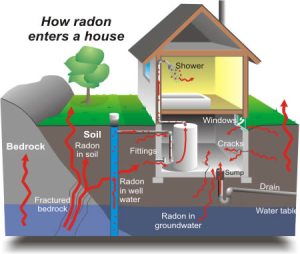
How Radon Gas Enters A Home

How Radon Gas Enters A Home!

We’ve had reason in recent days to re-investigate the risks of radon gas to our health. We got a lot of help from Elizabeth James, radon maven. [Thanks, Liz!]

The news is not good!
Radon, you will remember, is a colorless, odorless, tasteless, radioactive gas—the product of decomposing uranium deep in the earth.
Radioactive?
That can’t be good.
You’re right, it’s not.

According to the U. S. EPA online radon is a very serious threat to our health.                                                                     

Radon is the number one cause of lung cancer among non-smokers, according to EPA estimates. Overall, radon is the second leading cause of lung cancer.  Radon is responsible for about 21,000 lung cancer deaths every year. About 2,900 of these deaths occur among people who have never smoked. [emphasis mine, ed.]                  

It’s everywhere.  But, mostly, it’s in your house!

A silent, invisible, odorless, tasteless, radioactive killer gas is sneaking into my home to give me cancer? R-I-G-H-T!
Sounds like another eco-maniacal greenie off the deep end doesn’t it?

It’s not.

(BTW, our sincerest apology to all ecologically concerned individuals whom we may have just offended. We’re just trying to drive home a point here—not make a political statement. Really.)

And there’s more bad news.

You are at a greater risk of dangerous exposure to this killer stuff here in central Ohio than most other places!

Uh Oh!

This is serious business, and you need to find out more about the risk to you and your family and what you can do about it.

Do it because there are reasonable ways to reduce exposure. Do it because you want to be here for your grandchildren. (Okay, here’s the real reason. Simon says “Do it.”)

The EPA has a free booklet available on line that provide excellent general information. There is an additional free publication that addresses the special concerns of those considering buying or selling a home.

Possibly the best source of good information about radon in the central Ohio area is our new friend Elizabeth

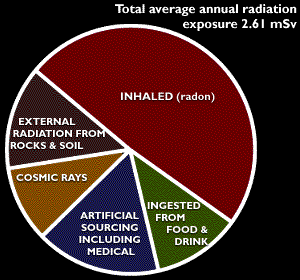
How We Are Exposed To Radon Gas!

How We Are Exposed To Radon Gas!

James at the Ohio Department of Health. (You were wondering when we were going to get back to her, didn’t you? Thanks for staying with us.)

Call Liz at 800-523-4439 and ask her some questions about this stuff. She’s an expert. Find out how serious this really is…and what you can do about it.

Go ahead call her…she’s really nice.

Tell her we said “Hi”.

You smokers with children. [You know who you are.] Stop smoking now and call Liz. Your risk is like 100 times worse! No kidding. Do it right now.

Buyer Agent George

 (This health safety blog story was reproduced from the Buyershome Journal”  blog – July 31, 2007)


AddThis Social Bookmark Button


Taxes

Taxes

Franklin County has a great automated monthly prepay system for paying your real estate taxes that will pay you interest.  The Franklin County Treasurer will pay the “average Joe” home owner the same interest rate that the Treasurer earns on its multi-million dollar portfolio.  This is really a groundbreaking achievement for the Franklin County Treasurer’s office.  The Treasurer sought and obtained a change in state law that allowed them to pay interest on monthly tax payments by home owners.  Banks are still NOT allowed to pay interest on escrow accounts that collect property tax payments.

The interest rate that you can earn from the Treasurer’s office will be a better rate than most short-term bank accounts (checking, savings or money market accounts).  For example, in 2007, the Treasurer’s interest rate fluctuated between 3.5% – 5.5%.  Last year, I had a so called “high yield money market account” with an investment company that only earned between 1.75% – 2.25%.  I think the Treasurer’s new monthly prepay system for real estate taxes that also pays interest is a first-rate service.   Many homeowners in Franklin County are not even aware of this service.

A  Franklin County home owner could possibly earn a couple hundred dollars a year.   For example, a $265,000 home in Franklin County with yearly real estate taxes of $5,000 a year would have approximately earned $200 – $220 in an interest credit for 2007. The interest that you earn will be credited back against your real estate taxes, to LOWER your taxes!  To get more info, you can visit the Franklin County Treasurer web site.  The process is very simple and easy to set up.  You just have to fill out one simple form.

If you are currently escrowing your real estate taxes with your lender then you will need to check with your lender to see if you are eligible to stop the escrow of real estate taxes.  Most lenders will allow you to stop escrowing for real estate taxes if you have 20% – 30% equity.  But, every bank has different policies and procedures, so before you do anything make sure you first check with your mortgage lender.  You want to make sure you are eligible and there are no fees or costs involved to stop escrowing for your real estate taxes.

As of right now, Franklin County is the only local county in central Ohio that offers this great service.  If you have questions, you can contact The Treasurer’s office for more information  (614) 462-7515. 

I think this is a wonderful service by our Treasurer’s office.  A great benefit for being a home owner in Franklin County.  You have the “worry free” convenience of automatic monthly payments of your real estate taxes that also pays you a great short term interest rate that you probably can’t get at any bank.  And best of all, the Treasurer’s program is FREE.  There is no fee or set up charge to join the program.

Shake Down!

Shake Down!

Don’t let the “Tax Man” shake you down!   Click here for other possible ways to reduce your property taxes and/or save some “greenbacks”! 

HomeBuyer Advocate Mike


AddThis Social Bookmark Button

Save Moolah!

Even a small amount ($25, $50, $100) added to your mortgage payment each month when applied to the principal can have a significant impact on the total amount of interest you pay as well as how long you pay it.

For example, if you divide your monthly mortgage payment by 12 and add that amount to your monthly payment each month by the end of the year you will have paid the equivalent of an extra mortgage payment for the year—a 13th payment—all invested in principal reduction!

That 13th payment can make a big difference. For example, let’s say you borrowed $200,000 at 6.5 percent interest with a 30 year term. Your monthly payment would be a shade over $1,264 a month for principal and interest. By adding an extra $100 per month ($1,200 per year) you would pay off your mortgage in just over 23 years, knocking almost seven years off the loan and saving over $73,000 in interest.

Contact your lender to find out how they apply extra payment money from you. Some lenders may apply your extra money that you pay above your monthly payment amount automatically to your principal.

However some may appy it to your escrow account to pay taxes or insurance which is NOT what you want them to do! Make sure you read the fine print, and call (or write) your lender to confirm what they will do, or how you can assure that the extra money goes to reducing your principal balance.

Tip: Sending a separate check and clearly marking the “memo” field with your loan account and the phrase, “Apply to Principal”will help assure proper credit and provide strong documentation of your extra payments. Again, check with your lender.

Tip: Don’t bother with offers from your lender or 3rd party companies that offer to charge you money (often as much as $200-$300) to set up a bi-weekly payment program—you can accomplish the same thing yourself without their help—for free.

IMPORTANT NOTE: Although this is a great strategy to accomplish the twin goals of saving money and increasing equity in the capital asset that is your home, this may not be the best use of your financial resources.

Interest rates for home mortgages tend to be lower than most other consumer loans and your financial profile may suggest a better use for this money—like paying off higher interest consumer loans first.

Anytime you pre-pay extra money on any installment loan it has the same effect as investing your money at that interest rate. So if you had an extra $100 should you pre-pay it on a home loan at 6.5% or a consumer loan at 10%, for example? And don’t forget that mortgage interest is usually fully tax deductable, whereas other consumer interest is not.

Therefore, we recommend consulting a qualified financial advisor for a proper evaluation of your total financial picture before proceeding with this strategy.

Buyer Agent George

(This money saving blog story was reproduced from the Buyershome Journal”  blog – April 12, 2007)


AddThis Social Bookmark Button

BUYER'S RESOURCE
REALTY SERVICES
7100 N. HIGH STREET
SUITE 204
WORTHINGTON, OH 43085
614.918.3336

Michael Marshall – Angie’s List Super Service Award 2013!

Get Informed Now!

Hip & Cool Counter

  • 106,536 Satisfied Customers!

HomeBuyer Advocate Mike

Unknown's avatar
Representing People, NOT Property in Columbus, Ohio. If you are a home buyer, then you need me to protect you. I can help you get the best price and terms for your next home purchase. You must use a true Buyer Broker! 1.614.805.7607

SEARCH HOMES!

Categories

January 2026
M T W T F S S
 1234
567891011
12131415161718
19202122232425
262728293031  
Zillow Home Value Index

Archives